The 2026 Thesis — Nine Structural Shifts Redrawing the Next Category Map
stephengilfus.com
The 2026 Thesis · Stephen Gilfus
An executive read on how AI, cybersecurity, vibe coding, innovation governance, entrepreneurship, and online learning are dissolving the operating model that defined enterprise software for two decades — and what the boards and founders who govern that shift will build in its place.
At a Glance
Each anchor below pulls forward a thread that runs through the full thesis. Read these first if you only have a minute — then drop into the nine shifts that follow.
AI at the Core
Peripheral AI buys time. Core AI redefines the product, the org, and the unit economics — and the firms that re-architect early define the next category.
Governance & Trust
Strategic partnerships, model exposure, and vendor relationships move into the formal committee structure as fiduciary obligations rather than IT decisions.
Vibe Coding
Prompt-driven, agentic production collapses build cost. Markets dismissed as too small under SaaS economics become viable for small operators with conviction.
Continuous Learning
Degree-and-done is replaced by AI-native, always-on skill formation. The institutions that govern that shift will define the workforce of the next decade.
The 2026 Thesis · Why Now
Nine structural shifts are collapsing the operating model that defined enterprise software for the last two decades. Boards and founders that read these shifts early will define the next category. Those that don't will defend a shrinking one.
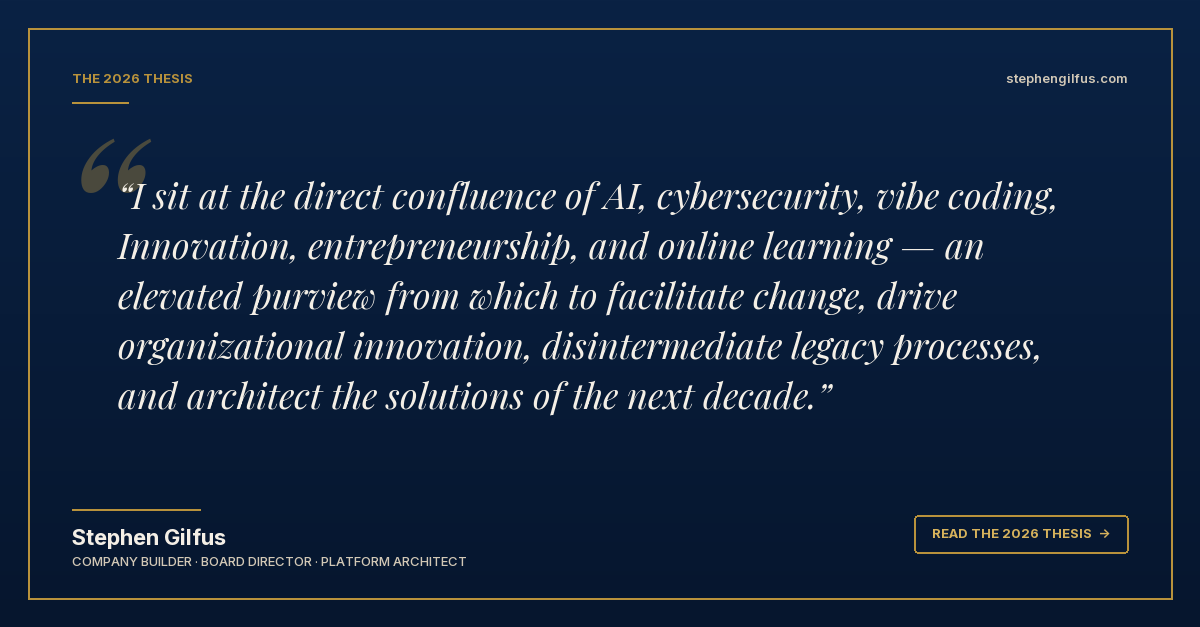
“I sit at the confluence of AI, cybersecurity, vibe coding, Innovation, entrepreneurship, and online learning—a vantage point to drive change, advance organizational innovation, streamline legacy processes, and design solutions for the next decade. The same forces are reshaping the way we live, the way we learn, and the way we work — and the leaders who can govern and capitalize on that shift, rather than react to it, will define the organizations and institutions that follow.”
AI belongs at the architectural core where it drives the most consequential changes — not bolted onto the periphery as patchwork. Peripheral AI enables 2.0-style methodologies that are only a fraction of what's inevitable, and they delay the real value AI is built to deliver. The winners rebuild from the center outward.
Organizational governance now formally elevates AI — and the strategic partnerships that surround it — into the committee structure. Boards stand up AI, risk, and technology committees with the authority to commission partnerships, oversee model exposure, and govern vendor relationships as fiduciary obligations.
Prompt-driven, agentic software production has collapsed the cost and accelerated the speed of building real products. Markets that were structurally unreachable under SaaS-era economics — niche regulated workflows, regional operators, micro-verticals — become viable for small operators with credit cards and conviction.
Markets are changing too quickly, and technology is advancing too fast, for innovation to live in a side lab. Boards now require continuous reconciliation between strategy and the underlying technology stack, making innovation oversight a permanent governance function rather than a periodic initiative.
Long-lived perimeters, static credentials, and persistent infrastructure give way to ephemeral, regenerable security constructs. As agentic systems generate and tear down environments on demand, the defensible posture is one of disposability, zero-trust by default, and continuous re-issuance — not hardened permanence.
AI doesn't just optimize incumbent value chains — it removes the intermediaries those chains were built to protect. Distribution, advisory, and aggregation layers that captured margin under the old model are collapsed by agentic systems that connect supply and demand directly, redrawing competitive paradigms at their foundation.
The way we learn is rebuilt around AI-native, always-on skill formation. The degree-and-done model is replaced by continuous, contextual reskilling embedded in the flow of work — and the institutions that govern that shift will define the workforce of the next decade rather than chase it.
Boards and operators who can govern AI, security, and velocity together define which institutions survive the transition. Strategy, technology, and risk converge into a single leadership discipline — and the directors who can hold all three at once become the scarcest asset on the cap table.
Low build cost combined with agentic tooling makes founder-led, niche-first companies the dominant organizational form of the next decade. The default career and capital path shifts away from joining incumbents and toward building inside markets too small or too specific for legacy players to defend.
The advisors and directors who matter in the next cycle are the ones who can govern AI as rigorously as they govern capital — and ship as fast as the market now demands.
Market Structure · 2026
Categories are no longer discovered — they are engineered in real time by the operators who see the shift first. When velocity, re-bundling, and new moats collide, the market map redraws itself in months, not years. The companies that name the new category usually own it. The ones that defend the old one usually fund the winners.
Velocity
Agentic build tooling and prompt-driven engineering have collapsed the time between insight and shipped product. Categories that took a decade to form in the SaaS era are now coalescing inside a single funding cycle.
Re-bundling
Buyers stop purchasing seats, modules, and point tools — they purchase finished work. Adjacent categories merge as a single agentic system absorbs what previously required five vendors and a systems integrator.
New Moats
When anyone can generate software, defensibility shifts to proprietary data, model governance, regulatory posture, and the institutional trust required to operate inside regulated workflows.
The next category leaders won't be the firms with the best roadmap. They'll be the ones with the clearest read on which market is dissolving — and the conviction to build the replacement before the incumbents notice.
Unit Economics · 2026
For two decades, venture math forced founders to chase trillion-dollar TAMs. Niches were left to consultants and spreadsheets because the cost of building real software couldn't be justified below a billion-dollar ceiling. That math has inverted. When the cost curve of production collapses, the addressable map expands — and the most defensible companies of the next decade are being built inside markets the last generation considered too small to enter.
Build cost
Agentic engineering, open models, and managed cloud have collapsed the marginal cost of producing functional software. A vertical product that required a 20-person team and $5M now ships with a small operator and a credit card.
Audience size
When production is cheap, the breakeven audience shrinks. Markets once dismissed as 'too small to fund' — niche regulated workflows, regional operators, micro-verticals — become structurally attractive businesses.
Distribution
AI-native search, community channels, and embedded agents let founders reach narrow buyers directly, without the enterprise sales motion that previously made niches uneconomical to serve.
100×
Drop in marginal build cost vs. 2015 SaaS baseline
500
Customers needed to support a category-leading niche product
weeks
From validated insight to shipped vertical product
The next generation of category leaders won't out-spend the incumbents. They'll out- address them — serving the markets that were never large enough to justify the old cost structure, and compounding from there.
Engagement
Private executive sessions, board briefings, and advisory engagements built around the nine shifts — tailored to your category, governance posture, and the decisions ahead of you in the next twelve months.
Share this page
LinkedIn, X, and Facebook will auto-render the branded quote card from this page's share metadata.
Link-Card Preview · 1200 × 630
Pasted into LinkedIn, X, or Facebook, the page unfurls as the card below — rendered here at the same 1200 × 630 aspect the platforms crawl.
The 2026 Thesis — Nine Structural Shifts Redrawing the Next Category Map
stephengilfus.com