Field Notes · By Stephen Gilfus · February 1, 2010
Community, Context, Content — The Platform That Supersedes the LMS
Revisiting the 2010 whitepaper on the Community Platform for Education with Frank Ganis.
Frank Ganis and I argued in 2010 that community theory and social technology were converging into a learning platform that would supersede the traditional LMS. The framework — community, context, content — still holds.
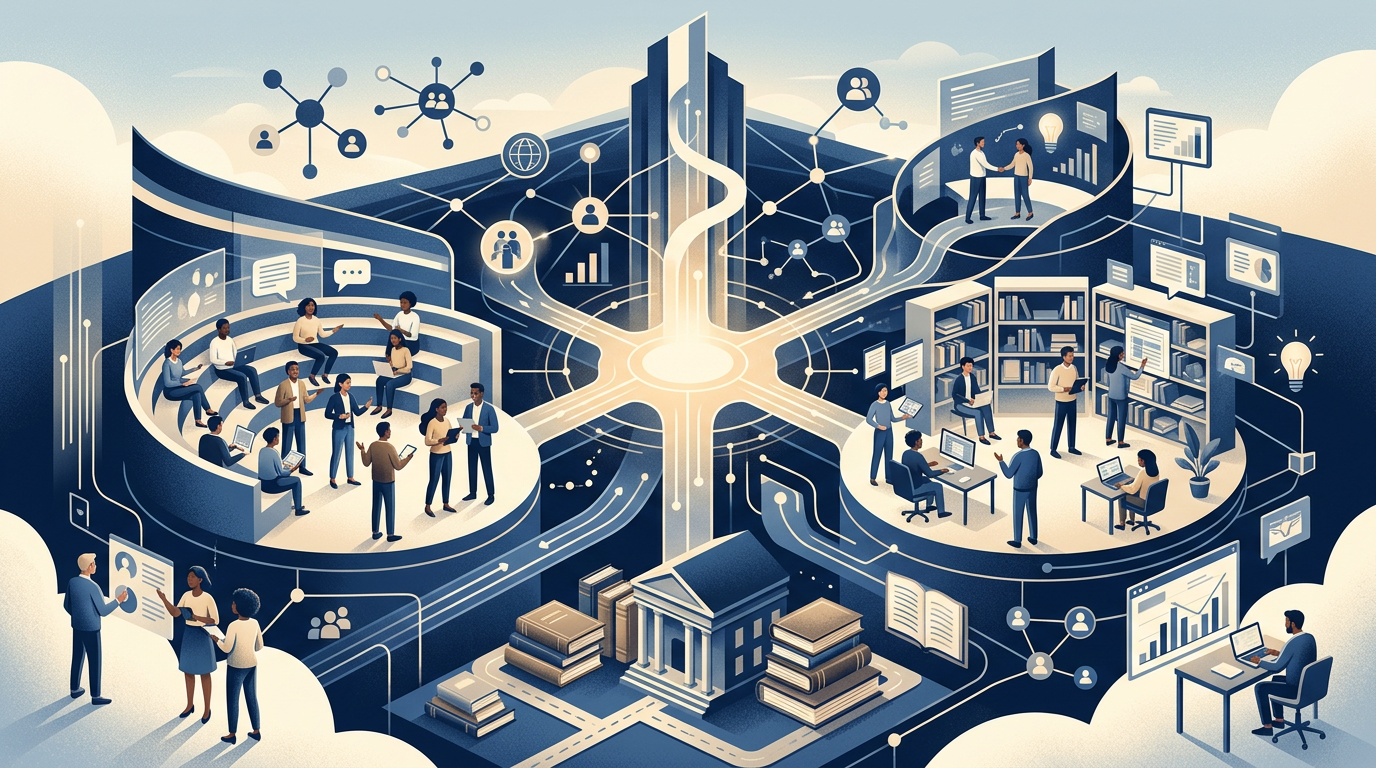
In 2010, Frank Ganis and I co-authored Community Platform for Education as a direct challenge to the prevailing LMS orthodoxy. The dominant model treated learning as content delivery: a course is a container, students are seats, and the platform's job is to ship PDFs and capture quiz scores. We argued that this was the wrong unit of analysis.
The whitepaper proposed three converging primitives:
Community — the persistent network of learners, faculty, mentors, and alumni that gives a course meaning beyond its sixteen weeks.
Context — the institutional, programmatic, and personal scaffolding that makes content actually relevant to a specific learner at a specific moment.
Content — the artifacts (readings, lectures, simulations, assessments) that the platform delivers, but which are increasingly the cheapest part of the system.
Sixteen years on, the model that won is exactly the one we described. Modern learning platforms — whether you call them learning experience platforms, talent platforms, or community platforms — all assume that community and context are first-class objects, not afterthoughts pinned to the side of a course shell.
The whitepaper was an early articulation of what would become the standard architecture. Worth re-reading if you're scoping any modern learning, talent, or community-of-practice platform.
Share